Hamilton, in his work, “For the Finest Art, Try Pop”, tries to explain pop-art in relation to two reactionary art movements of the 20th century, Dadaism and Futurism; two movements in which artists react to the modern society in constant change in an attempt to express an image of it and to take a critical standpoint against such a society. He invents the term “Mama” explicating that the pop-art is the product of these two movements initiating it: It both reacts the modern world like Dadaists (yet not as much as them), but it also appreciates−just like the Futurists, as they appreciate the velocity and change determining the modern world as of then−the values of this commercial society which turns every aesthetic value of the past into easily-consumable everyday objects. Hamilton states that pop-culture undertakes the role of mythmaking once belonged to the fine-arts via photography−his position towards photography as a possible art form is rather derogatory−, TV, comic strips, magazines−which may be even as base as Playboy. He clearly puts aside the avant-garde from this emerging pop-art, and talk of avant-garde as nostalgic, yet absolute−still has the capacity for inspiration as far as I understand him.
According to Oldenberg, pop-art is an escape from the bourgeois impositions on not only art, but every aspect of human life, which take its roots from b. Values of Maslow’s hierarchy, i.e. morality, aesthetics, drive towards freedom and knowledge etc. For Oldenberg, art escapes from bourgeoisie hegemony by either aristocracy or by intellect, to be built on different grounds other than b. Values. Then Odenberg asks that why does one wants to create an art, to base the work, object, one creates on some determined grounds. He then suggests that for art to be independent and critical creator of values, it is to exist independently with its exisence as an object−not with an outside reference to the artworld, museums, visitors etc. all of which belong to the bourgeoisie. All in all, Oldenberg while celebrating the technology of modern world also appreciates the artworks that are in fact no different than these technical every day objects, all are to be displayed in stores, not museums where the so-called art-works are left to decay.
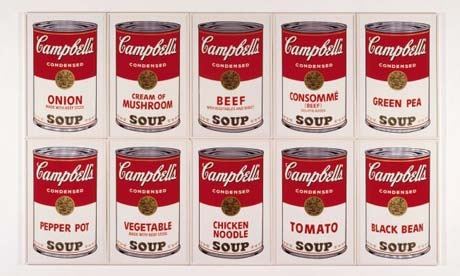
Andy Warhol interview lays out the loss of authenticity with the emergence of Pop-Art. He celebrates the modern phenomena in which everyone thinks, acts and creates alike, that is, there no longer exist a creation, but reproduction. The fact that Warhol has so little to say about his own art shows its inability to be in relation with the art history. As we see in all art movements before, Warhol employs silk-screening technique in his art’s ends to erase the artist’s authenticity and make him and his work lost in the masses of the modern times, just like the repetitive patterns of Warhol. Extremely disturbing ideas.
Reinhardt uses the term “art-as-art” to describe the real art which is freed from bourgeoisie values and from the imprisonment in museums in which it is devoid from all practical, socio-political content. He sees this form of art which makes references only to itself and which has faced and is aware of its history and processes that reveal itself as the real aim, thus the end of the art. By claiming this, he thinks that the artwork will escape commodification and stay on its own pure grounds.
Heartney argues in “Art and Today” that with Andy Warhol, the infamous separation between low art (Kitsch) and high art by Greenberg in his essay “Avantgarde and Kitsch” has lost its validity. For him the contemporary art has a positive and reproductiv relationship with the popular culture. He points out the Warhol’s effect on art attempting to express the weird modern times.
 BESTE GÜN ASLAN