Hugo Ball, the founder of Cabaret Voltaire which will later initiate most Dadaist artist together with Emmy Hennings, states in his “Dada Fragments” that, as the life asserts itself in contradictions, art of Dada–which encompasses the contradictions by being absurd, extraordinary, avant-garde and by employing an anomalous perspective–can be said to penetrate into the life more unlike the art of the past, which were founded on principles and temporality of contents. The “freedom” offered by Dada is not only a freedom in terms of the use of the media, but also the use of the content–in fact, abolishing the content as they claim that the content serves the interest of an individual and a group of individuals only–. Thus, for the first time, with this scandalous art movement, the artist had a saying and a provocative status against social and political issues, in the age of rising nationalism and wars–yet not by putting forward several principals, but introducing symmetries and rhythms.
Tristan Tzara, an important founding figure of Dadaist poetry, talks about the insolubility of the name “Dada” in his “Dada Manifesto 1918”. The nothingness and meaninglessness of the name “Dada” actually best explicates the incompatibility of Dada artists with the principles and rules and theories of society and art. New artist is a protester more than he is a creator. Tzara considers the art and social theories as the “laboratories of formal ideas”, and the certain values and rules enacted by an artist or theoretician as arbitrary choices of them that have no objective values, one may call it a “Boomboom” rather than “Ideal”, yet nothing changes inherently. Similarly, one may call Dada with a different name, yet the quality of its possessing no certain quality, its devoid of all principles remain still.
In “First German Dada Manifesto (Collective Dada Manifesto)”, Richard Huelsenbeck states that Dadaism refers to the most primitive relationship of man towards reality: It does not mean simple, naïve realism; instead, the turn towards seeking a new medium in painting on the grounds that the art of the past lacks universality of expression as it sticks to the local contents: The only way to eliminate this in to eliminate content as a whole and produce art with reflexes and instant emotions given by our medium (i.e. specializing the form). Huelsenbeck introduces three styles of poetry as Bruitish, Simultaneous and Static Poem all of which belong to Dadaist movement. In these styles of poetry, poet engage in a multi-language, multi-structural poetry where the rhythm and melody and sounds are more important than what is narrated by it. The painter, he suggests, should do the same with his paintings, Huelsenbeck suggests: In the case of poetry, now, the rhythm becomes pure colors and lines and other media expressed in the melodical unity of an artwork.
Giorgio de Chirico refers to the mystery in his paintings in “Mystery and Creation”, by pointing out the notion of mysterical presentiment of the world. For him, this is inherited from primitive man to us, and it is the proof that the universe is not completely rational. Because, in these presentiments regarding outer world one does not give an intelligible scientific account but gives only inspirations and free connotations. So, for him, the mystery and this primitive fact is the source of human creation and art.
Hans Arp, as well, comments in his introduction to a catalogue of a Dadaist exhibition that the artworks as pure constructions of lines, planes, forms and colors can be said to seek the eternal issues regarding humanity. Man Ray, then, names these qualities as creative force and expressiveness of an artwork–unlike local contents, they are the absolute qualities common in every artwork.
Lastly, in his essay “What is Surrealism?”, rather than giving a definition of it–he claims that as it in nature exists and develops in flux, it can only be defined after its death–he introduces a correspondence of “automatic writing” in Dadaist poetry in painting. The concept of poetic objectivity is important in that for Paul Eluard, poet concentrates the muses, images and any other subjective elements in a poem, while doing this the subjective elements are in the guide, not the artist himself. As a consequence, he ends up with aleatoric processes of painting, which focus on medium as other Dadaists suggest, as the most appropriate mode of expression close to automatic writing in poetry.
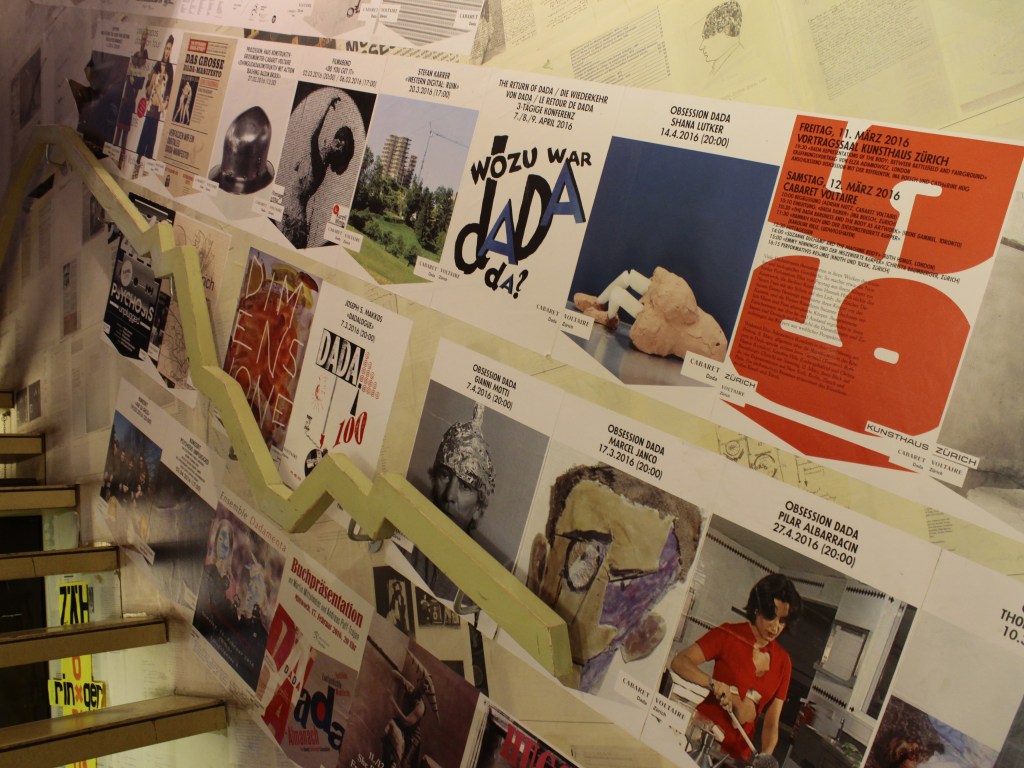
*Picture from Cabaret Voltaire, Zurich during Manifesta 11.
 BESTE GÜN ASLAN