Fluxus and the Reincarnation of Authenticity
“Monsieur G. does not like to be called an artist. Is he perhaps a
little right? His interests is the whole world; he wants to know,
understand and appreciate what happens on the surface of the
globe. The artist lives very little, if at all, the world of morals
and politics. It must be admitted that the majority of artists are
no more than a highly skilled animals, pure artisans, village
intellects, cottage brains. Their conversation becomes very
quickly unbearable to the man of the world, to the spiritual
citizens of the universe.”
Charles Baudelaire, from The Painter of Modern Life.
The notion of authenticity in aesthetics has gained the centrality of focus along with the modernity, as the relations of art and life started to be redefined constantly with the rapid technological and social changes of the “long” 20th century. Benjamin is the first to put the authenticity as a problematic issue of modern art, as opposed to positioning himself in a way that takes the notion of authenticity as something to be taken for granted when the work of art is the subject of our inquiry. In this essay, I will claim that the notion of authenticity is inseparable part of the defining characteristics of an artwork taking the Frankfurt School as my theoretical framework. Yet, this claim does not mean the sources of authenticity is the same as the pre-modern works of art; in fact, I point out the particular contemporary art movements (Fluxus and the related movements, focusing mainly on Joseph Beuys−my proposed “Monsieur G.” of the Age of Mechanical Reproduction−) which, I think, are in an attempt to rediscover the notion of authenticity by redefining and extending both the definition of art, artistic experience, and the relation of art and life.
In his influential essay, “The Work of Art in the Age of Mechanical Reproduction”, Benjamin discusses in detail the notion of authenticity in terms of artworks in relation to reproduction of artworks, which is a prevailing phenomenon of the modern society with the birth of new media of performing art such as film and photography. For Benjamin, the authenticity is the aura of an artwork, meaning its “unique presence in time and space, unique existence at the space where it happens to be, (…) the unique phenomenon of the distance” (Benjamin, 216) has lost with the introduction of reproducibility through such technologies. The last part of this description given above is of utmost importance as it defines the crucial and universal part of every aesthetic experience, in my conception. Because, if we define aura as “the unique phenomenon of the distance”−which would be intelligibly general definition which would be hard to reject−, it follows that the aura distinguishes the viewer/ the subject experiencing from the work of art by creating a sense of the distance and the detachment from the artwork as an object, which is necessary for an intelligible aesthetic experience. Just like one first visualizes agitated mythic figures above the eyelevel when thinking about Baroque sculptures, Benjamin associates the notion of aura with a historical era of making art in which traditional and ritualistic values control both the production process and the appreciation process of the artwork. New forms of art and representation shift our perception as well; the operation of senses change as well as humanity’s entire mode of existence with modernity. As a Marxian cultural critic, he emphasizes the role of historicity in shaping our “ways of seeing”, both the artworks and our lives. Thus, he concludes, the emerging technology of mechanical reproduction with the rise of modernity introduced in the domain of art declares the fading away of the aura. Yet, for me, what is absent, though necessary in Benjamin’s essay is that he does not in fact take a position about this loss of aura in modern world; he gives an account of it descriptively, but does not specifically claim that it is a necessary condition of performing arts, neither our need to regain it. In parts, he talks between the lines about the new media of arts’ use in the field of politics as it has no longer use in traditional and ritualistic accounts, but as I said, there is no explicit account of whether arts need the notion of authenticity to define and sustain itself universally−thus, in the modern world as well−and of the possibilities of new forms and sources of authenticity in his essay.
Adorno, in this respect, initiating from Benjamin’s account of the situation of work of art in the age of mechanical reproduction and also Heidegger’s definition of the origin of an artwork in relation to being and truth, introduces his unique theory of modern art. In his Aesthetic Theory, he engages in a reconstruction process of the theory of modern art movement dialectically from the perspective of Kant and Hegel. He poses two vital questions adopted to modern art from Hegel and Marx respectively: First, whether art can survive in the late capitalist world; second, whether art can contribute to the transformation of this world. What is obviously prevailing in this extremely difficult and scattered book is that the recurring notions which he takes from several philosophers. Most important of these are the notion of formal autonomy (concerning a domain of humanity) which he adopts from Kant, and the emphasis Marx puts on the art’s being embedded in a society and social relations as a whole. In fact, Adorno claims the autonomy−even if it is illusiory−is the necessary and the key part of the modern art. It can be understood as Benjamin’s claim that the art has no longer related to the tradition, religion and ritual in the modern world. But, although it is unclear in Benjamin, the fact that the art gained autonomy just like the modern man’s thinking capacities in a Kantian sense−bearing his famous his famous motto “Sapere Aude!”− does not necessarily mean that art in the modern world is completely freed from all repressive forces making it impossible to sustain itself without destruction of its essence. This is the pessimistic tone of Adorno and Horkheimer in their Dialectic of Enlightenment. They name what Benjamin talks about in rather an indifferent tone as the “mass production” in modern life as “Culture Industry”, and they claim that “A technological rationale is the rationale of domination itself. It is the coercive nature of society alienated from itself.” (Adorno and Horkheimer, 95) They see enlightenment−as it has developed to a degree that express everything in a progressive tone, similar to economic rationale (Ibid. 3)−as a means to mass deception of society and to control the masses in the hands of economic and political agents. Reproducible, of no aesthetic value so-called “artworks” are used in the hands of political agents to enable masses to identify themselves to the mass culture by destroying the sources of uniqueness and authenticity which are inherent to art. What Adorno and Horkheimer do in fact an early, farsighted critique of enlightenment and an infinite trust in human mind and capacities all of which end in two catastrophic world wars and in Auschwitz. At this point, it would be proper to mention Greenberg’s essay “Avant-Garde and Kitsch” in which he opposes functionally and contextually the avant-garde works of art and the “so-called” works of art that are used as a propaganda means to influence masses. Greenberg has a faith in modernism and the avant-garde artworks to resist to the mass deception of these kitsch works from the power-holders to support consumerism, fascism and everything that go against authentic activities of humanity, not only art.
Not as optimistic as Greenberg though, I claim that in Aesthetic Theory, Adorno investigates the conditions of experience and possibility of the work of art “after Auschwitz.”−which he claims in his essay “Cultural Criticism and Society” that is not possible in the old forms of naïve poetry and such anymore. Adorno theorizes the modern artworks as social monads−by deriving this notion from Leibniz’s Monadology with some changes that I will explain−that is they are both embedded in social relations and they are also independent from each other (Adorno 1997, 6). Yet, unlike Leibniz’s organic and harmonious wholeness of monads, Adorno presents a more dialectical process that differentiates him from Leibniz’s notion radically. Thus, in Adorno’s conceptualization, which I adopt and accept to be the most intelligible theory to make sense of the important effects of modernity in the field of art by reserving the rights to reshape it, artwork’s being at the same time both social and also autonomous from each other is set forth as the possibility of an authentic work of art in the modern world. Adorno claims that “The historical moment is constitutive of artworks; authentic works are those that surrender themselves to the historical substance of their age without reservation and without the presumption of being superior to it.” (Ibid. 250) One can infer from this key passage is that the modern artwork’s key characteristic of being both social and autonomous at the same time (thus, being a social monad) indicates the existence of authenticity and vice versa: The notion of authenticity is inseparable from art. It does not belong to the kitsch, as they are completely devoid of critical context and the experiencing subject’s critical engagement with the object. It aims direct control and surrender over its subjects, failing to satisfy the conditions of modern art as lacks authenticity and critical thinking.
What I infer from the overall account of Adorno is that art can survive the late capitalist modern society and it can even transform the whole world on the condition of possessing historicity and autonomy (i.e. defining features of its authenticity). The vitality of the problem of preserving the authenticity could be expressed in a concluding argument of mine: If the essential concept of modern art is the notion of autonomy, which Kant acknowledges as the defining characteristics of every domains of humanity from culture to science even religion along with modernity; then the attempts to ignore autonomy of art by using it to impose the predetermined ideas of a power-holder by neglecting the critical capacities of human agents (“kitsch” in Greenberg, and “Culture Industry” in Adorno and Horkheimer) is an over-stepping of the boundaries of art, the end-product is no longer an artwork. With modernism, not that the newly-introduced technological media downgrade the place of authenticity in aesthetics, on the contrary, it emphasizes its importance for aesthetic production and experience. “Intractably”−à la Danto−avant-garde works of contemporary art needs to keep up the pace with the changing relations of art and politics, and to redefine the ever-changing relations of art and life to escape the repressive forms of politics (mis)presenting itself to be an artwork as well.
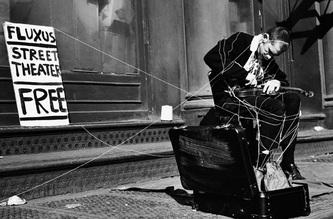
In the last part of my essay, as I think I lay out the theoretical and ideological background of my main inquiry, I would like to commit myself to what I think is the best example of what I mean by this redefinition of sources of authenticity in the modern world via the forms of “intractably” avant-garde contemporary art. What I have in my is the Fluxus movement of the early mid 60s, and Joseph Beuys as an artist related to this movement which is worthy of note while talking critically about the abandoning of hopes from the enlightenment as it ends up and the alternative ways for it; as this task is the overall aim of modern authentic art as I have discussed. Fluxus is one of the most complex art movements of early mid 60s, developing parallel with and opposite to Pop-art and minimalism in US and Nouveau Realisme in Europe (Foster, 497). The artists belonging to this movement such as John Cage, Yoko Ono, George Maciunas and Nam June Paik situate themselves as a movement of Neo-Dada, also they have international tendencies just as in Dadaists. Fluxus admit no distinction between art and life, they believed that everyday actions should be counted as artistic events as well. They present their performances through concerts, festivals, musicals and performations; they use many media of expression at the same time from music to collage, from the boxes full of every-day commodities and paper-made artifacts which they call flux-boxes and present in flux-shops to the performance art and happenings which find an extensive possibility of use with their involvement in the field of art. Fluxus was named by George Maciunas, who is himself also a Fluxus artist. Maciunas claimed to have found the name derived from the Latin fluere, to flow, by sticking a knife or finger into a dictionary−the method by which Dadaists claimed to have found theirs (Ibid. 498). The connotations of this name are also remarkable in the history of ideas from Heraclitus’s notion of flux as a situation of existence that everything is in and that we experience everything; to Hegel’s declaration of struggle and change as the father of everything. Also Henri Bergson sees natural evolution as a process of constant change and development, as a “fluxion”. He agrees that we do not experience the world moment by moment but constantly in one flow as we hear music. They attempt to eliminate the experiential differences between aesthetic and everyday objects. Even upon considering these points, one can claim that they are in search of a new ways of experiencing an artwork along with new ways to produce it. In that respect, they present the most crucial thing for every possible avant-garde art theory−that is, to represent the ever-changing relationship between art and life, also art and politics; keeping up the pace with that change, yet still staying in the artistic domain.
Joseph Beuys, for me, has all the characteristics shaping and transforming the Fluxus art. He represents the rupture from the Western civilization and its ideas of progression while ignoring the humanly and spiritual values of humanity which are necessary for sustaining and cherishing our existence. He is a radical environmentalist, not only for his own age, but also for today; because he labels some of his environmental and political actions as performance art−such as “7000 Oaks (1982)” (Beuys 2009, 26). Beuys names his art project as “social sculpture” in reference to his politically radical purposes and his expectations from art to realize them. For Beuys, every human being, even every animal is an artist in that they critically and creatively engage in constant relation with their environment and have capacity to change it materially and morally. After fighting as a war pilot in the World War 2 and having the wounds of so-called enlightened, civilized Western societies; he start his artistic life and begin to give lectures which he acclaims as an important part of his creative life. Later, Beuys constantly uses felt, butter, blood, animals in their performances in reference to the Crimean inhabitants who save and heal him with traditional methods when his warplane has crushed. He, in a similar manner, tries to heal the Western mind. In his aesthetics, we never encounter the socially pre-established forms of beauty, on the contrary, what we see is the constant rejection of them.
Beuys is the Monsieur G. of post-modern age, if I may say so; he is the true man of the world, and in close critical and creative engagement to the world affairs−which are set to be the preconditions of modern artist by the “father of modernity”, Baudelaire. In terms of aesthetics, he blends two forms of body art (Foster, 609): His performances are both a ritual reminding one of the earlier forms of art and an action against the settled rules. Beuys presents in its best form the “beauty” that can be achieved from the action and bodily performance. In his most notable performances named, “How to Explain Pictures to a Dead Hare” (1965), “Felt-TV” (1970), “I Like America and America Likes Me-Coyote” (1974) he follows his main moral and aesthetic theory decisively, which claims that one can engage in an artwork as a way of social transformation and reformation. In his artwork “Creativity=Capital” (1983) which can be described as a collage, he proves that he not only extends the boundaries of art , but he also extends the boundaries of capital which is a socio-economic concept in a way to include not only the repressive tool of economics and society as the power-holders hold against the others, but also to include the potential of creativity that everyone has and needs to put into actuality to transform the world and extend the possibilities of performing arts futher and even further.
Bibliography
Adorno, Theodor W. Aesthetic Theory. Bloomsbury Academic−Revelations Series, 1997.
Adorno, T.W. “Cultural Criticism and Society.” Accessed May 20, 2015. http://representingtheholocaust.wikispaces.com/file/view/Adorno_Cultural+Criticism.pdf
Adorno, T.W. and Horkheimer, M. Dialectic of Enlightenment. New York: Verso Books ,2010.
Baudelaire, Charles. Modern Hayatın Ressamı. İstanbul: İletişim, 2003.
Benjamin, Walter. “The Work of Art in the Age of Mechanical Reproduction” from Illuminations (pp. 214-218). London: Fontana, 1968.
Beuys, Joseph. Joseph Beuys-Aslolan Çizgidir Schloss Moyland Müzesi Koleksiyonundan Bir Seçki. İstanbul: Yapı Kredi Yayınları, 2005.
Beuys, Joseph. Joseph Beuys ve Öğrencileri: Deusche Bank Koleksiyonu’ndan Seçmeler. İstanbul: Sakıp Sabancı Müzesi, 2009.
Foster, Hal [et al.]. Art Since 1900: Modernism, Antimodernism, Postmodernism Vol.2. New York: Thomas &Hudson, 2011.
Greenberg, Clement. “Avant-Garde and Kitsch.” Partisan Review, 6:5 (1939) pp. 34-49.
Look, Brandon C. “Gottfried Wilhelm Leibniz.” Accessed May 20, 2015. http://plato.stanford.edu/entries/leibniz/#MonWorPhe
 BESTE GÜN ASLAN